The GSV-5H is a single-channel strain gauge amplifier for force sensors, torque sensors and strain transducers. It supplies excitation to the connected measurement bridge, amplifies its differential signal and provides the measured value as an analog voltage or current signal. The housing is 19.5 mm wide and designed for DIN rail mounting.
In its factory configuration, the GSV-5H operates with a measurement range of 2 mV/V, a voltage output of ±10 V and a low-pass cutoff frequency of 250 Hz. The signal path from the sensor input to the analog output is analog throughout.
The measurement range, output signal, zero output level and low-pass filter are configured via the NFC interface and the smartphone app. The measurement range can be set to 0.5, 1, 2 or 4 mV/V. The available low-pass cutoff frequencies are 30 Hz, 250 Hz, 2.5 kHz and 10 kHz.
Two threshold-controlled switching outputs allow the monitoring of limit values or signal ranges. The ZERO function for zero adjustment and the SHUNT function for electrical testing are activated via control inputs. The sensor, power supply, analog output and control signals are connected via spring-clamp terminals.
Configuration via smartphone app and NFC
The free “GSV-5H-APP” is available for Android and iPhone. An NFC-enabled smartphone can be used to read, modify and transfer the device settings to the amplifier. A PC is not required for configuration.
| Parameter |
Available settings |
| Measurement range |
0.5 / 1 / 2 / 4 mV/V |
| Output signal |
Voltage: ±10 V or 0…10 V
Current: 4…20 mA |
| Zero output level / offset |
0 V or 5 V, or 4 mA or 12 mA, depending on the selected output configuration |
| Low-pass cutoff frequency |
30 Hz / 250 Hz / 2.5 kHz / 10 kHz |
| Threshold detectors |
Upper and lower switching thresholds and switching mode: Hyst, HystInv, Win or WinInv |
The zero output level defines the output value provided by the amplifier after zero adjustment. It is therefore distinct from the lower and upper limits of the output range.
Terminal assignments
Sensor connection
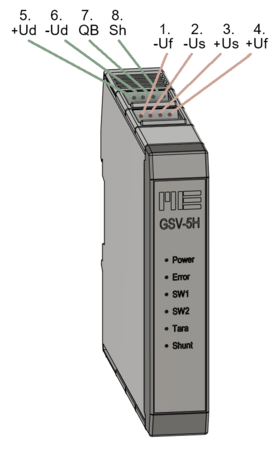
The sensor is connected to the upper terminal blocks. The following assignments describe the connection of a strain gauge full bridge.
| Terminal |
Designation |
Function |
| 1 |
-Uf |
Negative excitation sense lead |
| 2 |
-Us |
Negative sensor excitation |
| 3 |
+Us |
Positive sensor excitation |
| 4 |
+Uf |
Positive excitation sense lead |
| 5 |
+Ud |
Positive sensor signal |
| 6 |
-Ud |
Negative sensor signal |
| 8 |
Sh |
Sensor cable shield |
For sensors with a 6-wire connection, the sense leads are connected to -Uf and +Uf.
For sensors with a 4-wire connection, two jumpers are required: terminal 1 to terminal 2 (-Uf to -Us) and terminal 3 to terminal 4 (+Us to +Uf).
Power supply, analog output and control signals
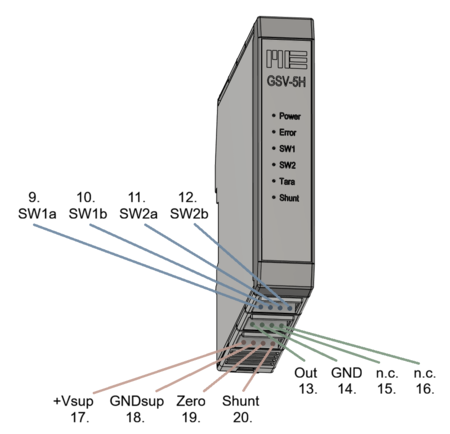
The power supply is connected to terminal 17 (+Vsup) and terminal 18 (GNDsup). The analog output signal is available at terminal 13 (Out), referenced to terminal 14 (GND).
The switching outputs are available at terminals 9 and 10 (SW1a/SW1b) and terminals 11 and 12 (SW2a/SW2b). The ZERO and SHUNT control inputs are located at terminals 19 and 20.
Functions
ZERO – zero adjustment / tare
The ZERO function sets the output signal to the configured zero output level at the sensor’s current load condition. To do this, the amplifier determines a correction value that is applied to subsequent measurements.
The correction value is stored in non-volatile memory and is retained when the power supply is switched off.
To activate the function, connect the ZERO input at terminal 19 to the supply voltage for at least 2 seconds. Zero adjustment takes place on the subsequent falling edge, when the control signal changes from High to Low.
The front-panel “Tara” LED remains illuminated while the ZERO input is High.
SHUNT – electrical function test
The SHUNT function electrically unbalances the connected measurement bridge. A resistor is connected between -Ud and -Us, placing it in parallel with one of the sensor’s bridge resistors. This causes the output signal to change in the positive direction without applying a mechanical load to the sensor. The function is controlled via the SHUNT input at terminal 20.
The magnitude of the bridge imbalance depends on the shunt resistance, the strain gauge resistances and the sensor’s electrical circuit. Additional resistors used for temperature compensation or sensitivity adjustment affect the signal step. The bridge imbalance is expressed in mV/V; the resulting voltage or current output also depends on the amplifier configuration.
The shunt test checks the electrical signal path comprising the measurement bridge, connecting cable and amplifier. It does not replace sensor calibration using a mechanical reference load.
Threshold detectors and switching outputs
The GSV-5H has two threshold detectors with switching outputs SW1 and SW2. In the closed state, there is a conductive connection between SW1a and SW1b or between SW2a and SW2b, respectively. The outputs use galvanically isolated solid-state relays. The maximum switching current is 0.5 A, and the maximum switching voltage is 60 V.
For threshold detector 1, the upper threshold TH1 U and the lower threshold TH1 L are configured. The corresponding settings for threshold detector 2 are TH2 U and TH2 L. Values are specified as a percentage of the measurement range. Each upper threshold must be greater than its corresponding lower threshold.
| Switching mode |
Output behavior |
| Hyst |
The output closes when the signal exceeds the upper threshold and opens when the signal falls below the lower threshold. Between the thresholds, the output retains its previous switching state. |
| HystInv |
The output opens when the signal exceeds the upper threshold and closes when the signal falls below the lower threshold. Between the thresholds, the output retains its previous switching state. |
| Win |
Window mode: The output is closed while the signal is within the range defined by the two thresholds and open when the signal is outside this range. |
| WinInv |
Inverted window mode: The output is open while the signal is within the range defined by the two thresholds and closed when the signal is outside this range. |
LED indicators
The front-panel LEDs indicate the operating status and the states of the switching outputs and control inputs.
| LED |
Meaning |
| Power |
Supply voltage present |
| Error |
Fault condition; identified by continuous illumination or a flashing pattern |
| SW1 |
Switching output 1 active |
| SW2 |
Switching output 2 active |
| Tara |
ZERO control input active |
| Shunt |
SHUNT control input active |
Error indication
| Error LED indication |
Meaning |
| Continuously illuminated |
The sensor signal check (UD test) has failed. Possible causes include a broken wire, an incorrect sensor connection or a defective sensor. The check reports a signal level below 1.25 V or above 3.5 V, or a differential voltage between +Ud and -Ud with a magnitude greater than 40 mV. Zero adjustment is not performed while this fault condition is present. |
| Slow flashing |
Error in the NFC configuration data |
| Flashing at 1 Hz |
Voltage output fault, for example due to a short circuit |
| Flashing at 2 Hz |
Current output fault, for example due to an open current loop; this indication may also occur when several faults are present simultaneously |
| Flashing at 4 Hz |
Output driver overtemperature |