
Call Us

We are ready to help

Request a special version

Didn't find what you were looking for?
This field cannot be empty.
This field must be at least 3 characters long.

Files

Drag & Drop files here or click to browse

File format supported: (.pdf, .zip, .docx, .png, .jpg .xlsx, .xls, .csv, .txt) & Max Filesize: 25mb

Need to be uploaded up 1 to 3 files.
File format supported: (.pdf, .zip, .docx, .png, .jpg .xlsx, .xls, .csv, .txt) & Max Filesize: 25mb
Leave your details so we can contact you
This field cannot be empty.
This field must be at least 3 characters long.
This field cannot be empty.
Please enter a valid email address.
This field cannot be empty.
Please enter a valid phone number.
This field cannot be empty.
Server error. Try again later.
Thank you!
We will send you a confirmation email and will contact you soon.
Don't have account yet? Register
Back to shopping

From standard (CV) to maximum precision (S): Why two calibration methods make the difference

Three-axis force sensors measure forces in multiple spatial directions simultaneously – crosstalk is physically unavoidable in this process.

Through a combination of mechanical and electrical compensation, this crosstalk can already be reduced to less than 3% of the nominal load. Nevertheless, a certain residual value remains, which is proportional to the applied force and behaves reproducibly. To further increase measurement accuracy, ME-Meßsysteme also employs a mathematical compensation matrix. With this method, crosstalk in all axes can typically be reduced to less than 1%.

Therefore, customers receive two calibration certificates: one without a compensation matrix (type "cv") and one with a compensation matrix (type "s"). This allows you to select the optimal calibration method for your application, depending on your requirements.
 

Higher measurement accuracy

Measurement deviations are systematically reduced – directly measurable.


Decoupled axes

Forces are clearly assigned to their respective directions.


Mathematically corrected

Matrix-based compensation instead of purely mechanical optimization.


Application-oriented

Measuring ranges and load cases to suit your application.


Ideal for R&D

Highest accuracy for complex measuring tasks.


Reliable results
Better data basis for decisions and validations.


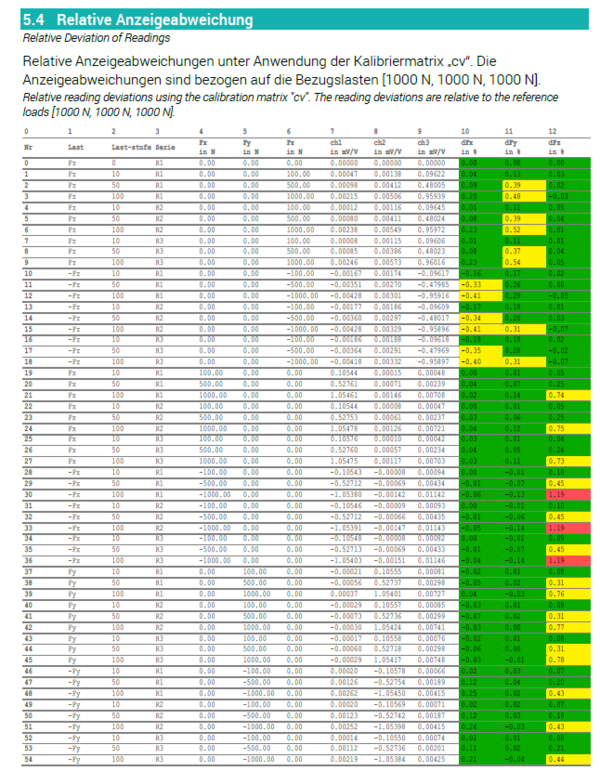
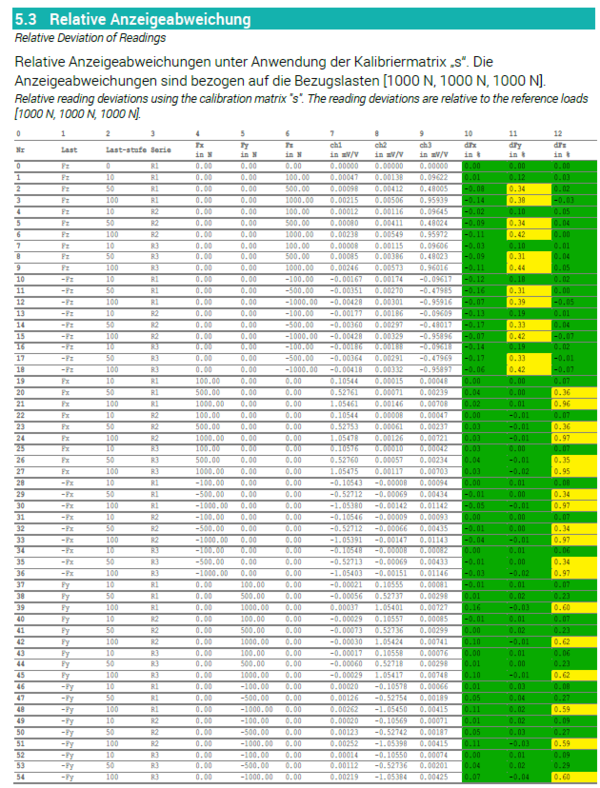
The following example compares two calibration matrices "cv" and "s".

Compensation matrix (type "cv")

Compensation matrix (type "s")

Factory calibration certificate 3D

With optional factory calibration for 4 to 6 measuring points, you ensure that your sensor is precisely tailored to your application. Simply select the desired number of calibration points – we handle the precise calibration and deliver a system that is ready for immediate use.

to 3D factory calibration

Professional expertise from the first conversation

Do you have a measurement challenge?

Talk directly to our engineers—we will find the right solution.


BOOK AN EXPERT APPOINTMENT

Dr. Holger Kabelitz

Managing Director

Specializing in complex 6D sensor technology, over 30 years of experience, expert in reengineering projects.

Michael Witich

Operational management

Ensures maximum process reliability and consistent quality – from manufacturing to calibration.

Dipl.-Ing. Wulf Wulff

Construction & Integration

Combines CAD, material behavior and signal processing to produce measurable results.

bars-filter